How to Regularise Unauthorised Development, Avoid Enforcement & Secure Approval
Local Knowledge Nationwide Expertise
Retrospective Planning Permission 2026
Average 5-Star Reviews
People Trust Planning World
We provide expert retrospective planning support for homeowners and developers who have built without planning permission. If you need a retrospective planning application, retrospective planning permission, or guidance after a planning breach, we offer fast, specialist advice. Our team prepares strong applications, handles planning refusals, and supports planning appeals when retrospective permission has been denied. Whether you’ve built an extension without permission or received a planning notice, we provide clear, practical guidance to help secure approval.
Planning World

Retrospective Planning Application Help
Built Without Planning Permission? Get Retrospective Planning Support
What Is Retrospective Planning Permission?
Retrospective planning permission is required when building work or a change of use has already taken place without planning approval. It allows the council to assess the development as built, rather than as proposed. If the development is acceptable in planning terms, it can be approved and regularised. If not, the council may take enforcement action.
When Retrospective Planning Is Required
You need retrospective planning permission when:
- You built something that required planning permission
- You exceeded permitted development limits
- You changed the use of a building without approval
- You built differently from the approved plans
- You relied on incorrect advice
- You misunderstood the planning rules
Retrospective Planning Permission Support
What Counts as Unauthorised Development
Unauthorised development includes:
- Extensions built without permission, or exceeded permitted development limits.
- Dormers added without approval, or exceeded permitted development limits.
- Loft conversions with front‑facing alterations
- Outbuildings used as living accommodation
- Garage conversions not within permitted development limits.
- Decking over 300mm
- Boundary walls or fences over height limits
- Change of use to HMO, outside of permitted development guidelines
- Commercial to residential conversions
PLANNING WORLD
Can provide a stress free solution to get your project back on track
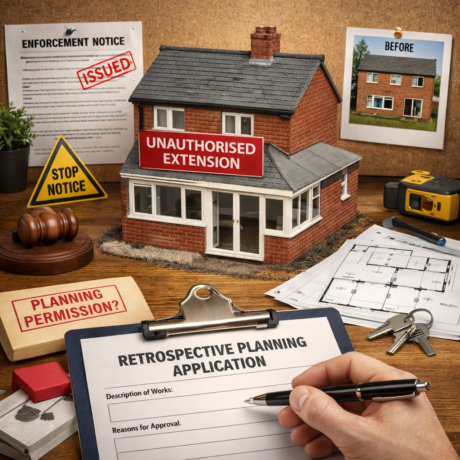
Common Examples of Unauthorised Works
- A rear extension exceeding permitted development
- A dormer facing the highway
- A garden room used as a bedroom
- A garage converted into a studio flat
- A shop converted into a takeaway
- A house converted into a 6+‑bed HMO
- Loft conversions with front‑facing alterations
- Outbuildings used as living accommodation
- Garage conversions
- Decking over 300mm
- Boundary walls or fences over height limits
- Change of use to HMO outside of permitted development
- Commercial to residential conversions
Built Without Planning Guidance?
What Happens If You Build Without Planning Permission
Building without planning permission is not a criminal offence, but it does place you at risk of enforcement action.
How Councils Discover Unauthorised Development
Councils typically find out through:
- Neighbour complaints
- Site inspections
- Aerial imagery
- Council tax triggers
- HMO licensing checks
- Planning history reviews
Initial Contact: PCN, Warning Letter or Site Visit
The council may issue:
- A Planning Contravention Notice (PCN)
- A warning letter
- A request for information
- A site visit appointment
These are fact‑finding steps, not enforcement.
When Enforcement Action Is Likely
Enforcement becomes likely when:
- The development causes harm
- The design is unacceptable
- Neighbours are affected
- The use is inappropriate
- The development breaches policy

How Likely Is Retrospective Planning to Be Approved
Retrospective applications are approved if the development is acceptable in planning terms. Councils must consider whether permission would have been granted if applied for correctly.
Situations Where Refusal Is Likely
Refusal is likely when:
- The extension is overbearing
- There is overshadowing
- There is loss of privacy
- The design harms the street scene
- The use creates noise or parking issues
- The development breaches design guides
How Planning Officers Assess Retrospective Applications
Officers assess:
- Design quality
- Scale and massing
- Impact on neighbours
- Highways and parking
- Local character
- Policy compliance
- Conservation area rules
- Amenity impacts
Situations Where Approval Is Likely
Approval is likely when:
- The work complies with planning policy
- The design is sympathetic
- There is no loss of light or privacy
- The scale is reasonable
- The use is appropriate
- The impact on neighbours is minimal
How Planning Officers Assess Retrospective Applications
Officers assess:
- Design quality
- Scale and massing
- Impact on neighbours
- Highways and parking
- Local character
- Policy compliance
- Conservation area rules
- Amenity impacts
Common Reasons That Trigger The Need For Retrospective Applications
- Overbearing Extensions
- Loss of Light or Privacy
- Overshadowing
- Out‑of‑Character Design
- Highways & Parking Issues
- Noise or Disturbance
- HMO Saturation
How Planning World can strengthen your Retrospective Application.
- Provide High‑Quality Drawings
- Submit a Strong Planning Statement
- Add Mitigation Measures
- Address Neighbours Concerns
- Demonstrate Policy Compliance
Required Documents Checklist
- Existing Drawings
- Proposed Drawings
- Elevations
- Site & Block Plans
- Planning Statement/Design & Access Statement
- Sunlight/Daylight Report*
- Heritage Statement*
Positive Feedback
7-day Turnaround
Fixed Pricing From
Why Choose Planning World for Retrospective Planning
- Specialists in enforcement, appeals, and unauthorised works
- Fast turnaround on drawings and statements
- High success rate with difficult cases
- Clear, fixed‑fee pricing
- Full handling of the entire process
FAQs — Retrospective Planning
Yes — if permission is refused and the development is considered to be harmful.
Not always, it depends on the individual case. Many are approved.
Only if you ignore enforcement.
Yes — to the Planning Inspectorate.
Yes — you can still apply for planning permission after an Enforcement Notice has been issued, but the rules change significantly once the notice exists
You can sell a property with unauthorised works, but:
- You must disclose the unauthorised works on the TA6 Property Information Form.
- Buyers’ solicitors will raise queries and may demand retrospective approval, regularisation, or indemnity insurance.
- If there is an active Enforcement Notice, the situation becomes more serious — the buyer inherits the notice and must comply.
Get Help With Retrospective Planning
Send us your documents or property details and we’ll prepare a fully compliant, retrospective planning appraisal, tailored to your specific requirements.